



A very strange thing happened a couple of years ago. During Justice Ketanji Brown Jackson’s Senate hearings for her appointment to the Supreme Court, Senator Marsha Blackburn of Tennessee read an excerpt from former Justice Ruth Bader Ginsburg’s majority opinion in The United States v. Virginia (1996). Her citation reveals just how much ground the sexual revolution has covered. In her opinion, Ginsburg wrote, “physical differences between men and women, however, are enduring. ‘[T]he two sexes are not fungible.’”[1] Senator Backburn then asked Justice Jackson whether or not she agreed with Justice Ginsburg that “there are physical differences between men and women that are enduring.” After a long pause, Jackson responded that she did not know ovo99 enough about the case to provide an answer. When pressed about whether she agreed with Ginsburg’s “meaning of men and women as male and female,” she again pleaded ignorance. Unsatisfied with Jackson’s obvious evasion, Senator Blackburn asked Justice Jackson a question whose answer exemplifies our current cultural moment. The exchange went like this:
Senator Blackburn: “Can you provide a definition for the word, woman?”
Justice Jackson: “Can I provide a definition? No. I can’t”
Senator Blackburn: “You can’t?”
Justice Jackson: “Not in this context. I’m not a biologist.”
This back-and-forth demonstrates that we have apparently reached that point in civilizational history when the social and educated elite who are tasked with analyzing sophisticated texts in order to interpret the law are unable to interpret the basic realities of human nature. As ethicist J. Alan Branch begins his essay in the subsequent pages of this journal, “Defining male and a female has become difficult for educated people.”
But defining the sexes has also become difficult for powerful people, as the appointment of transgender Richard L. Devine (known now as Rachel) to AssistantSecretary for Health and Human Services illustrates. Dr. Devine’s appointment clearly represents President Joe Biden’s attempt to virtue signal to the left and normalize transgender ideology in the highest halls of power. It seems rather difficult, however, for an institution whose mission is “to enhance the health and well-being of all Americans” to succeed when one of its top executives seems not to discern the enduring natural difference between male and female.
It has taken seismic worldview shifts to lead our culture to the point where it is not only acceptable, but celebrated that a cross-dressing, gender-confused man can hold one of the highest offices in the most powerful nation in human history — while pretending to be a woman. It is nevertheless curious that, even after the canonization of such gender dogma, we still have basically two commonly accepted genders: cis- or trans-gendered men and women. We suggest that these inconvenient observations are reflective of certain enduring natural differences that exist between male and female. Despite our attempts to escape the binary inherent in the created order, “the natural law finds a way.”[2]
For our part, we maintain that this failure to recognize the “fundamental facts”[3] of human nature is not owing to any ambiguity in the facts themselves. Rather, the basic, dimorphic nature of mankind is as apparent now as it has always been (Rom 1:26–27). God’s original design for man and woman endures: “So God created man in his own image, in the image of God he created him; male and female he created them” (Gen 1:27). We conclude that ideological rejections of these truths amount to willful suppression (Rom 1:18). And although we are grieved by this particularly destructive form of rebellion against our Lord, we are not surprised, given the naturalistic worldview that animates it. According to this worldview, creatures take the place of the Creator, determine the meaning of their bodies, and re-create them in their own image.[4]
But while our culture is captured by the blinding ideologies that prevent the patently obvious from being acknowledged as such, we seek in this installment of Eikon to do just that. Rejecting the politically correct for the theologically true, we declare that God made man male and female and that this design is very good (Gen 1:31).
Natural Complementarianism
CBMW began more than thirty years ago in response to forms of feminism taking root within evangelical churches and institutions. Central to the debate between those who became known as complementarians and their evangelical feminist (egalitarian) interlocutors was a concern for the roles of men and women in the home and the church. At the time, evangelicals seeking faithfulness to Scripture faced an evangelical feminism that challenged the traditional notion of gender roles between men and women. Today, however, biblically faithful Christians face challenges to the idea of men and women. In other words, the battlefront has moved from the roles of men and women to the fundamental reality that men and women exist as such.[5]
Building on the faithful teachings of complementarians who have gone before us, Eikon continues CBMW’s mission to defend truth “about the complementary differences between men and women, created equally in the image of God,”[6] especially on those points where it is most fiercely challenged today.[7] This defense of biblical truth requires that we reflect on and contemplate the natural differences between men and women — what they are, why they matter. While it is not the case, as some have argued, that earlier complementarians ignored or neglected the issue of the natural differences between men and women, it was certainly not the core of the debate as it is today.[8]
Since its inception in 2019, Eikon has been devoted to renewing and deepening evangelical complementarian convictions by seeking to understand how our God-given roles reflect and fit our God-given nature as male and female. And in this issue we give special attention to these natural differences in hopes of continuing to articulate a “natural complementarianism” — a complementarianism that recognizes that our complementary function is fitted to our complementarian form as male and female.[9]
For this purpose, we have gathered essays and arranged a forum to further our discussion on the nature and purpose of God’s design for men and women. In this issue we feature a programmatic essay by Kyle Claunch and Michael Carlino, which provides a dogmatic account of gender essentialism by employing the classic metaphysical distinction of essence and existence as a theologically warranted https://web.comillaboard.gov.bd/bisecb concept. Applying this metaphysic to the areas of anthropology, covenant theology, and Christology, Claunch and Carlino seek to correct well-meaning but misguided attempts to articulate the natural differences between men and women. We expect this essay will provide a reference point for these discussions moving forward.
Our readers will also benefit from Louis Marcos’s explanation and contemporary application of C.S. Lewis’s idea of the Tao, Alexander Strauch’s biblical reflections on how the pastoral office is fitted to men, J. Alan Branch’s commentary on the innate sexual differences between male and female, James Wood’s exploration of courage as a feminine virtue, as well as many other articles and book reviews worthy of your attention. As mentioned, we have also included a forum of various voices to discuss the natural differences between men and women from a biblical-theological, philosophical, cultural, and practical perspective.
It is our privilege as an editorial staff to continue carrying the complementarian torch forward to new generations, and to continue applying complementarian truth to new challenges as they arise. We therefore pray that this issue of Eikon will further equip you “to contend for the faith that was once for all delivered to the saints” (Jude 3).
Editorial Note: Paragraph 3 of this article has been corrected to reflect that Dr. Devine serves as the Assistant Secretary for Health and Human Services, rather than the Secretary for Health and Human Services.
[1] Justice Ginsberg cited Ballard v. United States, 329 U. S. 187, 193 (1946) in this quotation. “United States v. Virginia, 518 U.S. 515 (1996)” Justia US Supreme Court (accessed October 27, 2024), https://supreme.justia.com/cases/federal/us/518/515/.
[2] Our colleague Andrew T. Walker is fond of and credited with this apt phrase.
[3] See Joe Rigney, “Indicatives, Imperatives, and Applications: Reflections on Natural, Biblical, and Cultural Complementarianism” Eikon: A Journal for Biblical Anthropology 4.1 (Spring 2022): 26–34.
[4] See Nancy R. Pearcey, Love Thy Body: Answering Hard Questions about Life and Sexuality (Grand Rapids, MI: Baker Books, 2018).
[5] “Before the third edition of Discovering Biblical Equality, complementarians had to demonstrate the connection between egalitarianism and the erasure of male-female distinction by logic and inference. But now McKirland’s chapter connects the dots for us, and it brings the Christian to a decision point. Instead of rejecting gender essentialism to embrace an ideology that leads to the overthrow of the very foundations of nature in God’s good design, we should hold fast to everything that is good, true, and beautiful, which includes complementary humanity created male and female in God’s image for his glory” (p. 53). Colin J. Smothers, “Rejecting Gender Essentialism to Embrace Transgenderism?: A Response to Christa McKirkland, ‘Image of God and Divine Presence’” Eikon: A Journal for Biblical Anthropology 5.1 (Spring 2023): 46–53.
[6] This is quoted from CBMW’s Mission Statement. See “Mission and Vision” CBMW (accessed October 27, 2024), https://cbmw.org/about/mission-vision/.
[7] Francis Schaeffer attributed the following quote to Luther, although its exact provenance is not definitively known: “If I profess with the loudest voice and clearest exposition every portion of the truth of God except precisely that little point which the world and the devil are at that moment attacking, I am not confessing Christ, however boldly I may be professing Christ. Where the battle rages, there the loyalty of the soldier is proved, and to be steady on all the battlefield besides, is mere flight and disgrace if he flinches at that point.” Francis Schaeffer, The Complete Works of Francis Schaeffer: A Christian Worldview: Volume One: A Christian View of Philosophy and Culture (Wheaton, IL: Crossway, 1982), 11.
[8] John Piper rightly corrects those who — even in the pages of Eikon — have criticized the earlier complementarians for a lack of focus on nature. John Piper, “Danvers, Nashville, and Early Complementarianism” Eikon: A Journal for Biblical Anthropology 4.2 (Fall 2022): 28–33.
[9] As far as I am aware, Joe Rigney was the first person to use this term. See his “Indicatives, Imperatives, and Applications: Reflections on Natural, Biblical, and Cultural Complementarianism” Eikon: A Journal for Biblical Anthropology 4.1 (Spring 2022): 26–34.

Share This Article
-
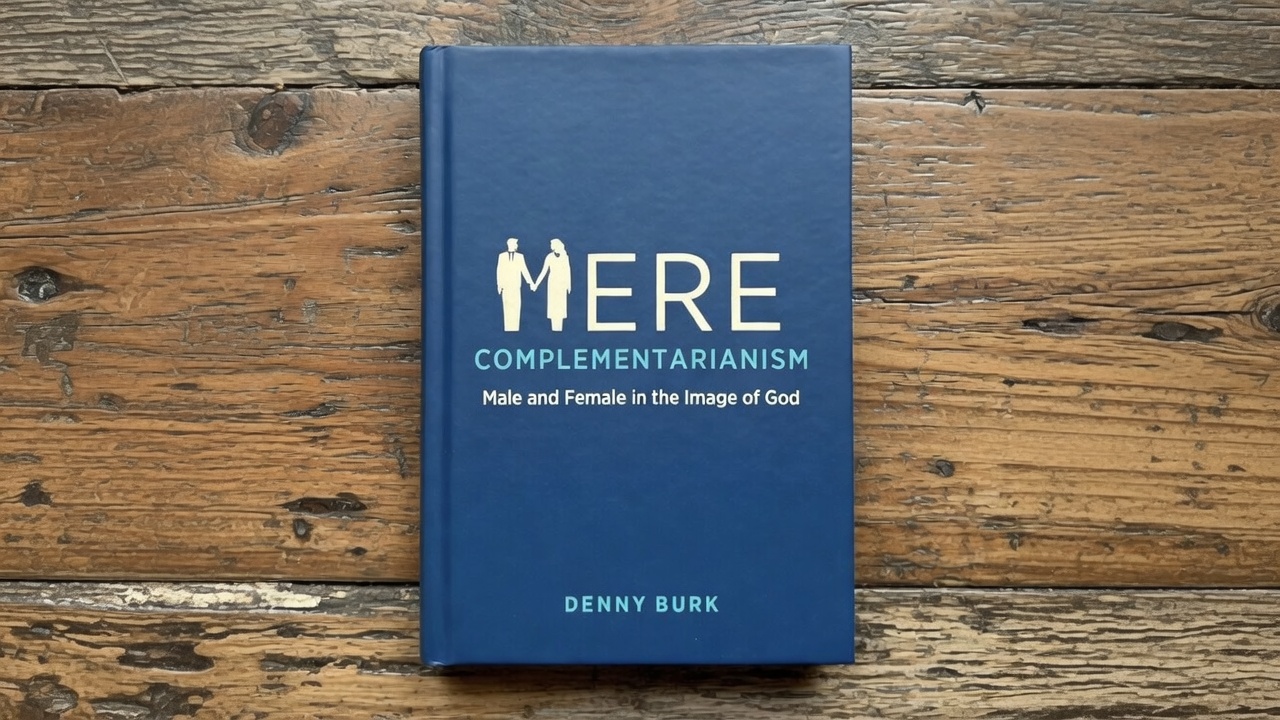
The Release of “Mere Complementarianism”
By Denny Burk
-

NEWS: SBC and PCA strengthen complementarian commitments
By Matt Damico
-

A New Evangelical Religion | Editorial
By Jonathan Swan